Jujube - Chinese Date
Country of Origin - China
Average Weight - 30 Grams
Introduction
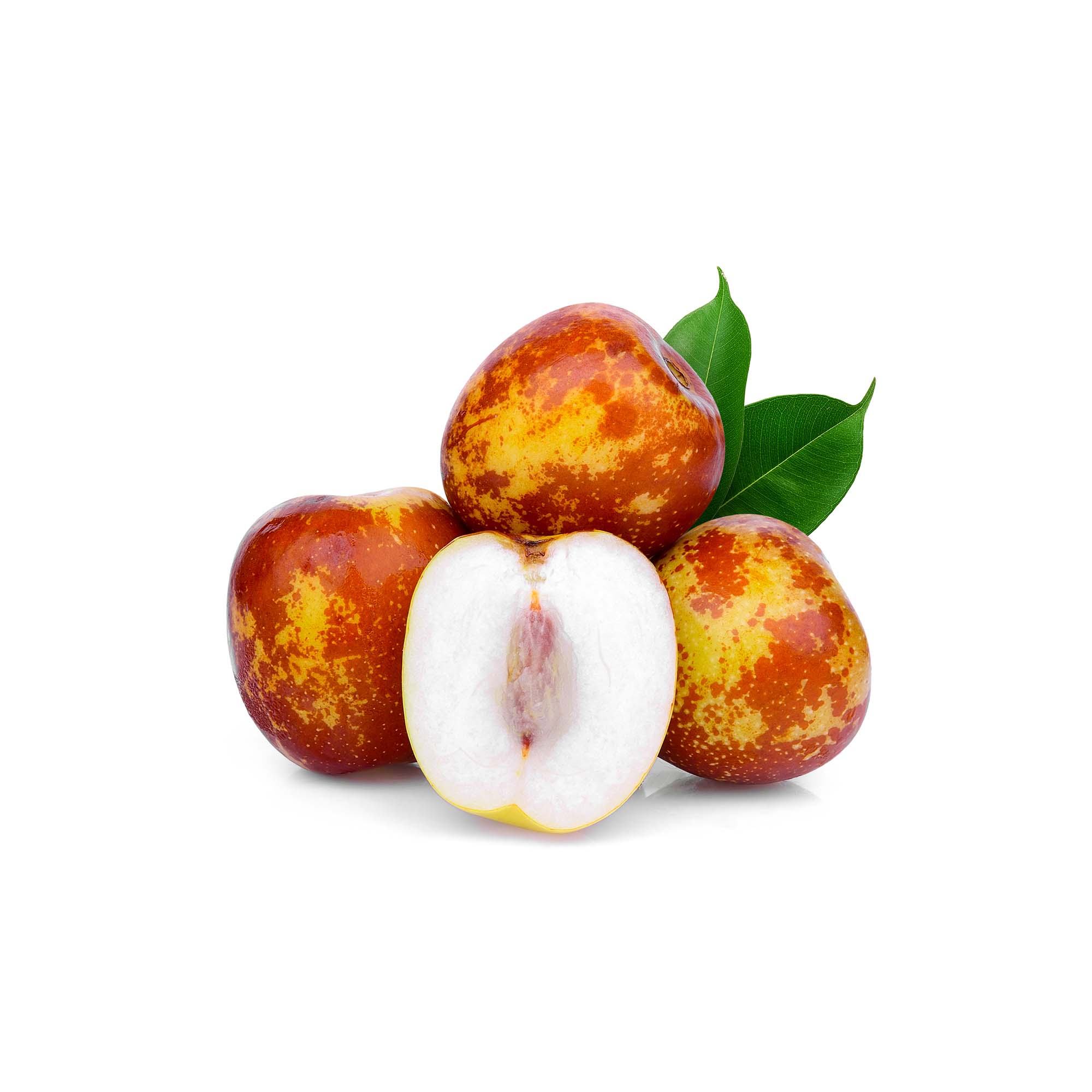
Jujube is a tropical fruit tree species – an evergreen shrub or small tree which produces fruits of variable shapes and sizes known as jujubes. Jujube Chinese Dates are also known as "red dates" or "Chinese dates", and have been loved for centuries due to their exquisite flavour and remarkable health benefits.
The Chinese Date Jujube grows in cooler temperatures, but is related to the less common Jujube Ber which grows in tropical/subtropical climates.
History
Jujube has been cultivated in China for more than 4000 years. From China it was initially introduced in countries bordering China. It was later introduced in European countries at the beginning of Christian era via the Silk Road. Later it was introduced in parts of Africa, Australia and during the 19th century it was also introduced in the USA and specifically in California.
Revered for its medicinal properties, Jujube Chinese Date holds a special place in traditional Chinese medicine and folklore. Throughout history, it has been valued for its ability to invigorate the body, enhance vitality, and promote overall well-being.
Regions
Jujube is distributed in at least 48 countries on all continents except Antarctica. China is the leading country in terms of production.
Flavours & Texture
Jujube Chinese Date offers a delightful combination of sweet and tangy flavors. Its taste can be described as a blend of honey, caramel, and subtle notes of apple. The fruit's texture varies depending on the ripeness—when fully ripe, it is plump, chewy, and has a slightly wrinkled skin. The crisp and juicy flesh of the Jujube Chinese Date provides a satisfying bite, leaving a sweet aftertaste that lingers on the palate.
Preparation
Jujube can be eaten out of hand as a snack but you can also cook it. You can use it in fruit salads, make juice, or in your smoothies.
Nutritional Value
Jujube contains a moderate amount of calories, it is rich in protein and fiber and it is an excellent source of iron and calcium.
|
Calories per 100 g |
281kcal |
|
Fat |
0.5 g |
|
Carbohydrates |
73 g |
|
Fiber |
6 g |
|
Protein |
4.7 g |
|
Calcium |
5 % of the RDI |
|
Potassium |
5 % of the RDI |
|
Iron |
28 % of the RDI |
Original: $1.27
-65%$1.27
$0.44Product Information
Product Information
Shipping & Returns
Shipping & Returns
Description
Country of Origin - China
Average Weight - 30 Grams
Introduction
Jujube is a tropical fruit tree species – an evergreen shrub or small tree which produces fruits of variable shapes and sizes known as jujubes. Jujube Chinese Dates are also known as "red dates" or "Chinese dates", and have been loved for centuries due to their exquisite flavour and remarkable health benefits.
The Chinese Date Jujube grows in cooler temperatures, but is related to the less common Jujube Ber which grows in tropical/subtropical climates.
History
Jujube has been cultivated in China for more than 4000 years. From China it was initially introduced in countries bordering China. It was later introduced in European countries at the beginning of Christian era via the Silk Road. Later it was introduced in parts of Africa, Australia and during the 19th century it was also introduced in the USA and specifically in California.
Revered for its medicinal properties, Jujube Chinese Date holds a special place in traditional Chinese medicine and folklore. Throughout history, it has been valued for its ability to invigorate the body, enhance vitality, and promote overall well-being.
Regions
Jujube is distributed in at least 48 countries on all continents except Antarctica. China is the leading country in terms of production.
Flavours & Texture
Jujube Chinese Date offers a delightful combination of sweet and tangy flavors. Its taste can be described as a blend of honey, caramel, and subtle notes of apple. The fruit's texture varies depending on the ripeness—when fully ripe, it is plump, chewy, and has a slightly wrinkled skin. The crisp and juicy flesh of the Jujube Chinese Date provides a satisfying bite, leaving a sweet aftertaste that lingers on the palate.
Preparation
Jujube can be eaten out of hand as a snack but you can also cook it. You can use it in fruit salads, make juice, or in your smoothies.
Nutritional Value
Jujube contains a moderate amount of calories, it is rich in protein and fiber and it is an excellent source of iron and calcium.
|
Calories per 100 g |
281kcal |
|
Fat |
0.5 g |
|
Carbohydrates |
73 g |
|
Fiber |
6 g |
|
Protein |
4.7 g |
|
Calcium |
5 % of the RDI |
|
Potassium |
5 % of the RDI |
|
Iron |
28 % of the RDI |